On June 16, 2026, Governor DeSantis signed SB 1332 into law.[i] Effective October 1, 2026, Florida’s Career Offender Registration Act gets a dramatic overhaul, one that has generated almost no serious legal commentary despite raising constitutional questions that should concern anyone working in criminal defense, reentry, or civil rights law.
This post is not a summary of what the law says. Other organizations have done that. This is an analysis of what the law does, who it actually reaches, and why several of its provisions deserve to be challenged before the first arrest for failure to register ever occurs.
What Changed
The Florida Career Offender Registration Act has existed since 2002.[ii] Prior to SB 1332, it required career offenders released after July 1, 2002 to provide their address and basic identifying information with FDLE or the local sheriff within two working days of release, and to update that information when it changed. Noncompliance was a felony. That was essentially the whole scheme.[iii]
SB 1332 transforms it into something categorically different:
Who This Actually Reaches
“Career offender” sounds like a category reserved for the most dangerous, most prolific violent criminals. The statute tells a more complicated story.
Under § 775.261, a career offender is anyone designated as a habitual violent felony offender, a violent career criminal, a three-time violent felony offender, or a prison releasee reoffender (PRR) under § 775.082(9). These four designations carry very different profiles, very different sentence lengths, and very different populations, and SB 1332 treats them identically.[v]
The PRR designation is the most important one to understand for purposes of this law. A PRR is someone who committed a new felony within three years of release from a prior prison sentence. The predicate offense does not have to be violent. The new offense does not have to be violent. A person released from prison on a drug possession conviction who is rearrested on a third-degree felony within three years qualifies. Under PRR, the court must impose the statutory maximum for the new offense and must serve 100% of the sentence with no gain time.[vi]
Florida does not publish a single consolidated count of all felony offenses on the books, but there are hundreds of distinct felony statutes—many of them third-degree, many of them non-violent, and many of them the kind of offense that would surprise most people.[vii] A few examples of third-degree felonies that can be in that chain:
Consider what a real PRR pathway can look like in practice. Someone gets drunk on the beach with friends, poses for a photo with a sea turtle, posts it online, and gets reported to FWC. That’s a third-degree felony under § 379.2431, carrying up to five years. She serves a year and a day, gets out, rebuilds her life, has kids. Two years later, short on cash before payday, she writes a check to the grocery store hoping it clears before the bank notices. It doesn’t. That’s another third-degree felony under § 832.05, and because it happened within three years of her release from that prior prison sentence, she is now a Prison Releasee Reoffender. She serves five years at 100%, no gain time. She walks out carrying a PRR designation that will brand her driver’s license and require her to report annually to the sheriff’s office for a minimum of 20 years. No violence. No victims in any meaningful sense. A sea turtle and a bounced check.
That example is not meant to suggest that all registrants are nonviolent. It is meant to show that SB 1332 reaches people whose qualifying conduct may be wholly nonviolent, yet subjects them to the same public branding and reporting burdens as people with violent career-offender histories.
SB 1332 does not distinguish between those groups in any meaningful way. That is precisely the problem. The person who picked up a PRR designation from a drug possession charge three years after a prior prison sentence is carrying the same registry designation as someone who committed three separate violent felonies. SB 1332 does not distinguish between them.
There is one designation conspicuously absent from the registry: the habitual felony offender (HFO). HFO requires only prior felony convictions and a new felony committed within five years of release. The predicate offenses and the new offense can all be entirely non-violent, making the HFO profile virtually identical to a PRR in many cases. Yet HFO is not included in § 775.261.
The difference is not dangerousness. The difference is discretion. HFO is a discretionary enhancement. The court may impose it. PRR is mandatory. The court must impost it. The court has no discretion. If the purpose of the registry were truly public safety notification, the HFO offender would be just as relevant as the PRR. The fact that one is included and the other is not suggests the registry was designed around a population, not a risk level.
A search of the FDLE Career Offender Registry in June 2026 within a five-mile radius of in my Florida neighborhood returned 41 registered career offenders.[xv] Out of those registrants, 35 (roughly 85%) carried the PRR designations. Six were HVFO, and none were designated VCC or the three-time violent felony offender. Every HVFO registrant, was already under active supervision. While this was just one search I did myself, a few additional searches of other random neighborhoods, turned up similar results. This is in no means meant to be representative of the whole registry or a substitution of actual analytics and data. It was, however, enough to show that my hypothesis was not out in left field. The registry in practice appears to mainly function as a PRR registry which makes sense. The designations that carry the longest sentences are either still incarcerated or already monitored through existing supervision structures. The people SB 1332’s new requirements will actually reach are the ones who have completed their sentences entirely and have no ongoing criminal justice contact.
Meanwhile, a violent career criminal convicted of a second-degree felony faces a mandatory minimum of 30 years.[xvi] They are not getting out anytime soon. The population actually populates this registry: the people doing annual birthday-month check-ins at the sheriff’s office and carrying a statutory citation on their driver’s license, is disproportionately composed of people who served the shortest sentences, which by definition means people designated for less serious underlying conduct.
The law’s practical effect is inverted from its stated purpose: the most dangerous designees are incapacitated by their sentences. The registration burden falls almost entirely on those who were rehabilitated enough to be released.
What FDLE Said It Was. What It Actually Is.
When Florida’s original Career Offender Registration Act took effect in 2002, FDLE described it this way: “This registration law assists law enforcement agencies in timely apprehending a career offender if they engage again in criminal conduct. Registration is not a punishment, but merely a status.” Registration information, FDLE noted, “is public record and may be released to the public.”[xvii]
That framing (notification, not punishment; status, not sentence) was the legal and political foundation on which the original scheme rested. It was modest in scope precisely because it had to be. A scheme that looked like punishment would face constitutional scrutiny as punishment. So it was designed to look like a phone book entry: here is where this person lives, here is what they look like, here is where they work.
SB 1332 appears to abandon that framing in practice. At the signing event, DeSantis did not say the registry would help law enforcement locate career offenders if they reoffended. He said “when you have career criminals, they are going to re-offend. You have to keep them off the street.”[xviii] That is not the language of notification. It is the language of incapacitation. And if the goal is incapacitation, a registration scheme riddled with independent felony tripwires sounds like a good a mechanism for achieving it without having to lengthen the underlying sentences.
FDLE’s own leadership has gone further. The same agency that in 2002 called registration “merely a status” now describes the people it covers as a uniformly dangerous class. At the June 2026 signing, FDLE Commissioner Mark Glass put it this way: “The career offender is not little Johnny going to steal a candy bar at the food store. The career offender is the one who’s been deemed by the court that continuously keeps coming through here, and these are your violent ones.”[xix]
The distance between “merely a status” and “these are your violent ones” is the entire problem in miniature, and the second statement is simply wrong. SB 1332 reaches four designations, and the statute itself separates the violent ones—habitual violent felony offender, violent career criminal, and three-time violent felony offender—from the prison releasee reoffender, which requires no violence in either the predicate or the triggering offense. The Legislature drew that line deliberately. When the official charged with administering the registry tells the public that career offenders are “your violent ones,” he collapses the very category the statute keeps separate. That is not loose talk at a press event. It is the assumption a landlord, an employer, or an officer carries into every encounter with the mark, and it is exactly the misinformation that a neutral “status” was never supposed to carry.
Florida’s mandatory minimum sentencing structure for PRR offenses locks sentences in at the statutory maximum. The legislature cannot easily add five years to a PRR sentence without rewriting the felony classification structure. What they did instead was create a 20-year supervision regime on the back end that generates new felony exposure for every missed disclosure. The sentence stays the same. The punitive tail gets four times longer.
This Is Probation. Just Without the Probation Officer.
The legislature has framed SB 1332 as a regulatory scheme: a public safety notification system, not punishment. That characterization deserves scrutiny.
Probation is not the same thing as registry, but the comparison is useful because it highlights the shared features that matter constitutionally. Both systems can require recurring in-person reporting, ongoing disclosure, travel reporting, and immediate criminal consequences for noncompliance. But that similarity should not be overstated: the pre-SB 1332 career offender scheme did not impose annual in-person reporting, did not require routine in-person check-ins except as tied to driver’s license renewal practices, and did not require disclosure of phone numbers or vehicles. SB 1332 changes that. It now adds annual in-person registration, broader disclosure duties, and even disclosure tied to vehicles registered to other household members. The point is not that registry and probation are identical. The point is that SB 1332 moves the registry much closer to a supervision regime by layering on obligations the prior version did not contain.
The difference is equally important. Probation is supervised by a probation officer, cabined by a defined term, and backed by judicial oversight if a violation is alleged. SB 1332 imposes many of the same burdens without the individualized supervision, flexibility, or built-in judicial process that usually accompany probationary conditions. That makes the scheme look less like neutral notification and more like unsupervised post-sentence supervision.
Courts evaluating whether a registration or notification scheme constitutes punishment for constitutional purposes apply the factors set out in Kennedy v. Mendoza-Martinez, 372 U.S. 144 (1963), and refined in Smith v. Doe, 538 U.S. 84 (2003).xvi Those factors ask whether the scheme imposes an affirmative disability or restraint, whether it resembles historical forms of punishment, whether it promotes the traditional aims of punishment such as retribution and deterrence, and whether it is excessive in relation to its stated regulatory purpose.
The travel reporting requirements alone, including the new definition of temporary residence, impose a direct restraint on movement. SB 1332 reduces the threshold from 14 aggregate days to 3 aggregate days in a calendar year. In practical terms, staying at a girlfriend’s house three separate nights over the course of the year can trigger a duty to report that address. That is not a trivial administrative detail. It is a rule that changes where someone can stay, when they can travel, and whether they are willing to accept ordinary overnight plans without first considering public registration consequences.
Probation and parole are historical forms of punishment. DeSantis said career offenders “are going to re-offend” and need to be “kept off the street.” Not might, not are likely to, not some will, and not even, many will likely. Instead he said "career criminals . . . are going to re-offend" as if this is a fact for all career offenders.[xx]
That framework matters because SB 1332 demands recurring appearances, imposes a branded identifier on a driver’s license, broadens public disclosure, and turns what would otherwise be a compliance lapse into a new felony offense. In functional terms, those are the hallmarks of supervision. The state can call the scheme regulatory, but a court is not required to accept the label if the effect is punitive.[xxi]
The License Designation Anomaly
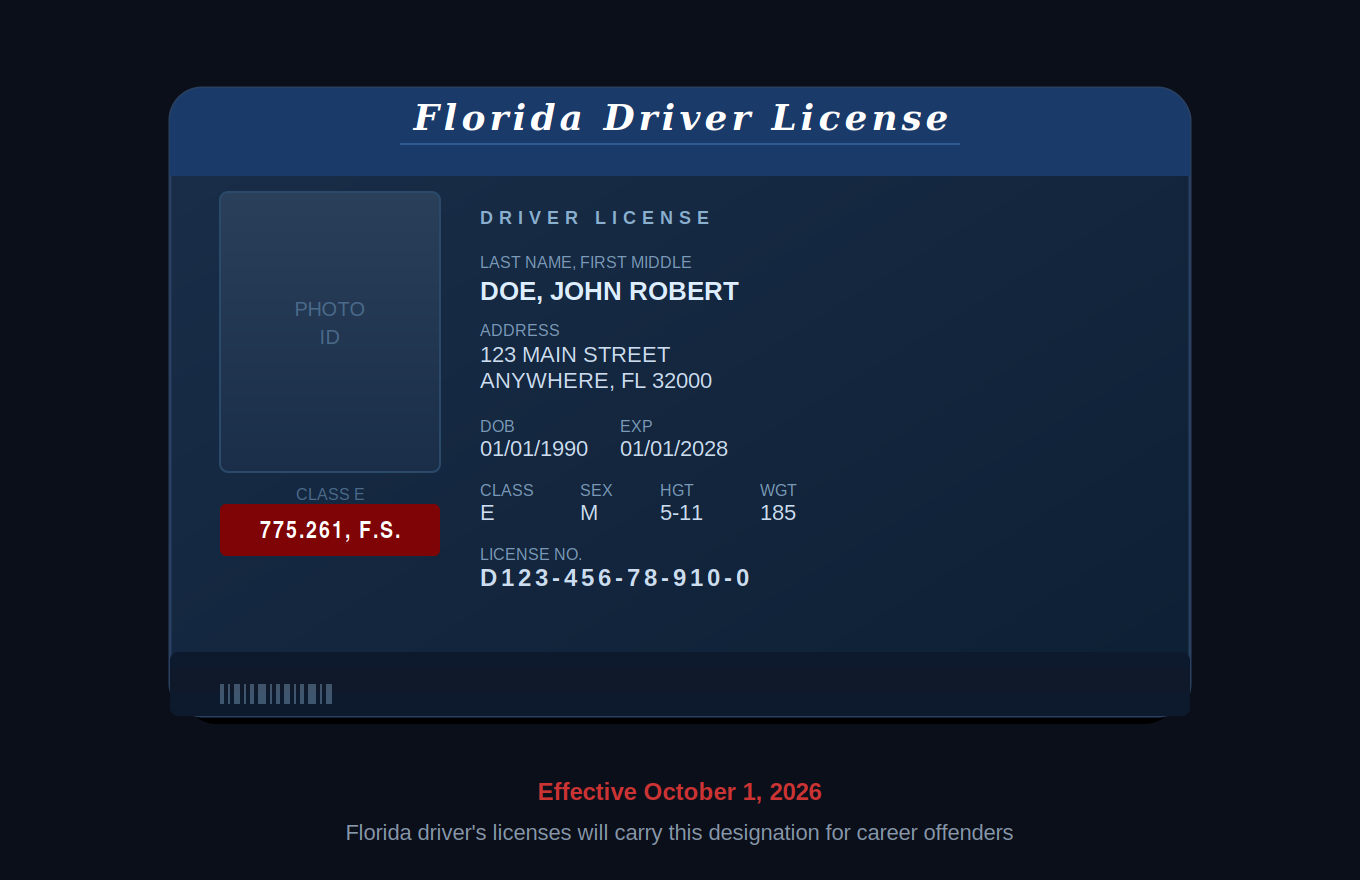
One of the most striking features of SB 1332 is something almost nobody has noted: sex offenders subject to registration under § 943.0435 receive the marking “943.0435, F.S.” on their license. Sexual predators under § 775.21 receive the marking “SEXUAL PREDATOR.”
Career offenders receive “775.261, F.S.”[xxii]
That distinction matters. The legislature chose a plain-English warning for sexual predators and a statute number for sex offenders, signaling that the two designations are not identical in public-facing severity or branding. SB 1332 departs from that approach by giving every career offender the same neutral-looking citation, regardless of whether the designation rests on a PRR conviction chain or on an HVFO, three-time violent felony offender, or violent career criminal designation. In other words, the statute collapses materially different categories into one mark.
The practical question is what that mark communicates in the real world. A leasing agent, employer, police officer, or even a member of the public may not know what “775.261, F.S.” means. Some will treat it as a generic felony marker; others will not understand it at all. But anyone who recognizes it as a registration label will almost certainly read it as a warning that the person is dangerous, without knowing whether the underlying designation was based on a nonviolent PRR pathway or repeated violent conduct. That mismatch creates the obvious question: if the state’s purpose is accurate public notification, why use a label that obscures the very distinction the legislature itself made elsewhere?
That leads to the unanswered implementation questions. Has FDLE standardized how the marking will appear across license types? Will the number alone be enough for law enforcement to interpret it correctly, or will the public assume it means sex offender? Will employers and landlords treat all career offenders the same because the mark gives them no distinguishing information? And, perhaps most importantly, what happens in the real world when the state chooses a citation that tells the public someone is registered, but not why, not how serious the underlying conduct was, and not whether the person before them is actually dangerous?
Those are the problems SB 1332 creates by design. The law deliberately removes gradation from the public-facing mark, and that is what makes the registry branding vulnerable to challenge as overinclusive, misleading, and punitive in effect.
The Third-Party Problems
The public record aspect of this registry extends well beyond the registrant. SB 1332 requires disclosure of all phone numbers used by the registrant, which in a household context may include shared landlines or numbers registered to family members.
It also requires disclosure of all vehicles registered to anyone else who resides at the registrant’s address for five or more consecutive days. The make, model, VIN, and license plate of a car the registrant may never drive becomes a public record associated with a career offender registration. That means a spouse’s car, a roommate’s car, or a parent’s car may become part of the registrant’s public disclosure. SB 1332 places only one limit on this, and it is narrow: FDLE “may not display on or disseminate through the Internet public registry” a vehicle owned by a person who is not required to register. That carve-out does not make the information confidential or exempt—it remains a public record. It closes a single channel, the online registry, while leaving every other route open: a written public-records request under Chapter 119 still reaches the vehicle data, as does the toll-free line and any other dissemination FDLE deems appropriate. And because the bill never defines “Internet public registry,” even though FDLE now pushes the same registry through both its website and a mobile app, it is not even clear the carve-out reaches every internet channel the agency already operates.
Florida has an extensive public record exemption framework protecting domestic violence victims, protected witnesses, judges, law enforcement officers, and others under §§ 119.071 and 741.465. SB 1332 does little to reconcile those exemptions with the mandatory public disclosure of registration information. The only nod to the problem is in § 944.609, which permits release of career-offender information to the public “unless the information is confidential or exempt from s. 119.07(1)” and the constitutional public-records provision. But that clause appears in the pre-release notification section, not in § 775.261, which declares the registration list itself a public record disseminable “ by any means deemed appropriate” with no comparable carve-out—and in any event it limits only what the agency may release, not the registrant’s obligation to provide and register the address in the first place. A career offender who lives with a domestic violence victim whose address is exempt from public record is therefore still required to register that address, and the statute never squarely resolves the conflict.
A career offender who lives with someone not subject to registration can nonetheless create spillover obligations for that person’s vehicle. If John Doe is not the registrant, but he lives with a registrant whose address requires disclosure of all vehicles associated with the household, John’s car may be swept into the registry record even though he has no criminal history and no registration burden of his own. The practical consequence is straightforward: an innocent driver can become publicly linked to someone else’s status, and every stop in that car may begin with information about the vehicle before the officer ever speaks to the driver. That is not just a privacy problem for the household; it is a public-record problem that affects third parties who never committed the underlying offense. A law that turns a family car into a registry identifier does not just regulate the registrant; it pre-frames every stop involving anyone who drives that car.
Beyond the legal exemption problem, a registry that makes public the vehicles, phone numbers, addresses, and employers associated with a career offender is a harassment infrastructure. The original FDLE framing of registration as “merely a status” assumed that status would be used by law enforcement for legitimate notification purposes. SB 1332’s mandatory public record disclosure assumes no such limitation.
The Traffic Stop
A Black man in his late twenties has served five years on a PRR designation stemming from two nonviolent felonies. He did his time. He earned a college degree while incarcerated and is working on his master’s. He wants to move closer to his children, whose mother relocated while he was inside. He applies for apartments. The license marking appears on every tour request. He cannot even make it to the background check that would show he is not violent. Landlord after landlord passes. He cannot get housing near his kids.
Now he is driving at night in a car he bought three days earlier, still on a temp tag. A patrol officer runs the plate and sees an address discrepancy. The stop begins on a minor traffic issue.[xxiii] When the officer sees “775.261, F.S.” on the license, the state has already supplied a stigmatizing signal: this is someone the state has chosen to register and publicly mark as a career offender.
The question is not whether the officer later has access to more information. He usually will. The question is what happens in the first seconds of the stop, before that background check occurs. Does the officer treat the driver as a routine motorist, or as someone already flagged as dangerous? Does he tell the driver to keep his hands visible? Does he ask him to step out of the car?[xxiv] Does he draw his weapon?[xxv] Does a quick movement toward the glove box or center console get read as something more threatening because the officer has already seen the designation? Those are the moments that decide whether a stop stays ordinary or becomes dangerous.
That matters because traffic stops are already high-discretion encounters, and the risk of escalation is not distributed evenly across drivers. For a Black registrant, the combination of a public brand, a stop initiated for a routine reason, and documented racial disparities in traffic enforcement can turn an ordinary encounter into one where force becomes a realistic possibility. The point is not that every stop will end in violence. The point is that the law increases the chance that the registrant will be treated as a threat before the facts are even known. The predictable consequence of placing a threat signal on a document carried by a disproportionately Black population, in a state with documented racial disparities in traffic enforcement and use of force, is not speculation. It is arithmetic.[xxvi]
The designation communicates threat level without communicating facts. For some people, that distinction will be the last one that matters.
The Notice Problem
Before turning to the practical implementation failures, the threshold issue is notice. The Due Process Clause requires constitutionally adequate notice before the government can impose new criminally enforceable obligations, and retroactive statutory burdens raise additional fair-warning concerns when they attach new sanctions to conduct already completed.[xxvii]
Here, the concern is not abstract. SB 1332 changes the rules for people already in the system, and it does so on a compressed timeline. That creates at least three separate notice questions: whether people leaving custody will actually be told the new requirements; whether FDLE and local sheriffs have the administrative capacity to receive and process them; and whether the agencies responsible for implementation have prepared the paperwork, procedures, and staffing necessary to avoid trapping people in technical noncompliance.
That concern is not hypothetical. FDLE’s own registration website currently overstates even the existing requirement: until October 1, 2026, § 775.261(4) asks only that an offender provide the required information to FDLE or the sheriff’s office within two working days, and imposes no in-person requirement for that initial registration—yet the site has been instructing registrants that they must report in person.[xxviii] An agency that cannot state the law it administers accurately, before the far more demanding version even takes effect, does not inspire confidence that the new in-person, sheriff-only regime will be communicated correctly to the people it now binds.
Those questions matter because the statute does not merely create a reporting obligation. It creates felony exposure for missing that obligation. If the state wants to criminalize noncompliance, it has to do more than announce the rule in the abstract. It has to give affected people a realistic chance to learn it and comply with it.
The notice problem is not limited to people releasing after October 1. The new requirements apply to the approximately 6,800 career offenders already living in Florida communities.[xxix] FDLE's own fiscal analysis acknowledges this, noting that FDLE will “notify non-incarcerated career offenders of the legislative changes via a mailout, budget allowing.”[xxx]
That leads to the practical problem questions the statute does not answer. Has the release paperwork been revised? Has FDLE actually budgeted for the notices to the roughly 6,800 people already living in the community? Are sheriff’s offices staffed and trained to process in-person registrations on weekends, when the 48-hour clock will frequently run out? What happens if a registrant appears on time and nobody is available to accept the filing?
Those are not minor administrative details. They go directly to whether the law is workable at all. A criminal registration regime that turns on a short deadline cannot be enforced fairly if the government has not made the process accessible.
The same concern applies to people who enter pleas after the law takes effect, and to those whose pleas were entered before the new obligations existed. A plea must be knowing, voluntary, and intelligent, and Florida courts commonly describe plea agreements as bargains governed by contract principles, subject to constitutional limits.[xxxi] A plea entered without meaningful advisement about mandatory in-person reporting, license branding, annual registration, and separate felony liability for missing a disclosure requirement will invite later litigation over voluntariness, ineffective assistance, and due process. For defendants who enter pleas after June 16, 2026, counsel will need to advise them of the registration consequences because those consequences are now direct, mandatory, and practically inevitable.[xxxii]For defendants who pled earlier, the new obligations were not part of the bargain at all, which sharpens the notice, voluntariness, and due process objections.
Ex Post Facto Question
The Ex Post Facto Clause bars retroactive laws that impose new punishment for conduct already completed; it does not bar every retroactive regulatory measure. The critical question is whether SB 1332 is punitive in purpose or effect when applied to registrants whose relevant convictions and sentences predate June 16, 2026.[xxxiii]
The strongest ex post facto point is not that the statute uses old convictions as a trigger; Smith assumed that a civil registry could do that. The better argument is that SB 1332 materially increases the burdens attached to convictions that were already final, and it does so in a way that is qualitatively different from the Alaska scheme upheld in Smith. Mandatory in-person reporting, a branded driver’s license, expanded public disclosure, and the conversion of each reporting lapse into a separate felony are all facts that support a renewed punitive-effects challenge.
That said, the Supreme Court has been deferential in this area. Under Collins v. Youngblood, 497 U.S. 37 (1990) and Smith v. Doe, 538 U.S. 84 (2003), the state will argue that SB 1332 remains a civil regulatory scheme aimed at public safety, not punishment. Any ex post facto challenge will therefore turn on whether a court views the new obligations as a materially more onerous version of registration, or merely a more detailed one.
I do not have all the answers, just more questions. But what I do know, is that someone should challenge this and that they should not wait until October 1, 2026 to do so.
One final note. A man designated as a career offender was released from prison in 2019. Someone photographed him at the DMV—smiling, genuinely happy to be getting his driver’s license back. He was 64. He is now 70. The clock for his petition eligibility runs from lawful release from confinement, supervision, or sanction, whichever is later. He will need to reach 20 arrest-free years to petition. He will be in his mid-eighties if he lives that long.
That is what “merely a status” looks like on a human being.
Post Conviction Project, Inc. is a Florida Supreme Court-approved nonprofit organization providing post-conviction legal services and reentry support. This post is for educational and informational purposes only and does not constitute legal advice. Reading this post does not create an attorney-client relationship.
Elisabeth Whitmire is CEO and Director of Legal Services of Post Conviction Project, Inc. and has been licensed to practice law in Florida since 2014.
Contact: postconvictionproject.org
Sources
[i] CS/SB 1332 (2026), signed June 16, 2026. https://www.flsenate.gov/Session/Bill/2026/1332
[ii] The Florida Career Offender Registration Act, § 775.261, Fla. Stat. (2002).
[iii] § 775.261, Fla. Stat. (2025) (pre-amendment version). https://www.leg.state.fl.us/statutes/index.cfm?App_mode=Display_Statute&URL=0700-0799/0775/Sections/0775.261.html
[iv] CS/SB 1332 (2026), enrolled bill, §§ 2–3.
https://www.flsenate.gov/Session/Bill/2026/1332/BillText/er/HTML
[v] § 775.261(2)(a); § 775.082(9); § 775.084, Fla. Stat.
[vi] § 775.082(9)(a)3., Fla. Stat. Senate Bill Analysis, CS/SB 1332 (2026):
https://flsenate.gov/Session/Bill/2026/1332/Analyses/2026s01332.fp.PDF
[vii] § 921.0022, Fla. Stat. Unlisted felonies default to third-degree under § 775.081.
[viii] § 379.2431(1)(e)5., Fla. Stat.
[ix] § 812.014, Fla. Stat.
[x] § 823.06, Fla. Stat. (enacted 1891). https://www.flsenate.gov/Laws/Statutes/2022/823.06
[xi] § 832.05(2)(b) & (4)(c), Fla. Stat.
[xii] § 322.34(2)(c), Fla. Stat.
[xiii] § 104.15, Fla. Stat.
[xiv] § 893.13(6)(a), Fla. Stat.
[xv] § 775.084(1)(d), Fla. Stat.
[xvi] Kennedy v. Mendoza-Martinez, 372 U.S. 144 (1963); Smith v. Doe, 538 U.S. 84 (2003).
[xvii] Governor Ron DeSantis, remarks at bill signing, June 16, 2026. https://www.wuwf.org/florida-news/2026-06-16/desantis-signs-law-enforcement-bills-including-career-offender-license-designation
[xviii] Does #1–5 v. Snyder, 834 F.3d 696 (6th Cir. 2016); Millard v. Rankin, 265 F. Supp. 3d 1211 (D. Colo. 2017).
[xix] § 322.141(3)(c), Fla. Stat. (as amended by CS/SB 1332, § 1).
[xx] FDLE Commissioner Mark Glass, remarks at bill signing, June 16, 2026. https://www.cfpublic.org/politics/2026-06-17/desantis-signs-law-enforcement-bills
[xxi] Whren v. United States, 517 U.S. 806 (1996).
[xxii] Pennsylvania v. Mimms, 434 U.S. 106 (1977); Maryland v. Wilson, 519 U.S. 408 (1997).
[xxiii] Graham v. Connor, 490 U.S. 386 (1989).
[xxiv] Stanford Open Policing Project: https://openpolicing.stanford.edu/findings/.
[xxv] Padilla v. Kentucky, 559 U.S. 356 (2010).
[xxvi] CS/SB 1332 (2026), Senate Bill Analysis:
https://flsenate.gov/Session/Bill/2026/1332/Analyses/2026s01332.fp.PDF
[xxvii] See generally Mathews v. Eldridge, 424 U.S. 319 (1976); Lambert v. California, 355 U.S. 225 (1957); Bouie v. City of Columbia, 378 U.S. 347 (1964).
[xxviii] Florida Department of Law Enforcement, Career Offender Registry (COAST), statutory information page. https://coffender.fdle.state.fl.us/coffender/coast/flStatutes.jsf
[xxix] Florida Department of Law Enforcement, Career Offender Registry (COAST), Frequently Asked Questions, https://coffender.fdle.state.fl.us/coffender/coast/faq.jsf, and Important Information, https://coffender.fdle.state.fl.us/coffender/coast/important.jsf.
[xxx] Author’s search of the Florida Department of Law Enforcement Career Offender Registry (COAST), June 2026. https://coffender.fdle.state.fl.us/coffender/coast/neighborhoodSearch.jsf
[xxxi] See generally Boykin v. Alabama, 395 U.S. 238 (1969); Brady v. United States, 397 U.S. 742 (1970); Hill v. Lockhart, 474 U.S. 52 (1985); Padilla v. Kentucky, 559 U.S. 356 (2010).
[xxxii] § 775.082(9)(a)3., Fla. Stat. Senate Bill Analysis, CS/SB 1332 (2026): https://flsenate.gov/Session/Bill/2026/1332/Analyses/2026s01332.fp.PDF
[xxxiii] Collins v. Youngblood, 497 U.S. 37 (1990); Smith v. Doe, 538 U.S. 84 (2003); Kennedy v. Mendoza-Martinez, 372 U.S. 144 (1963).